Townhouse or duplex? The words sound alike, and plenty of listings blur them. In North Carolina, the real difference is not the shared wall. It is what you own, who else owns a piece of it, and how a lender and an insurer see the home.
If you are shopping in Gastonia, Bessemer City, or the Charlotte side of the market, that difference shapes your down payment, your monthly costs, and what you can do with the property later. This guide covers both home types in plain terms, with North Carolina rules and Gaston County numbers, so you can compare listings with the right questions in hand.
The Short Version
| Key Point | Insight |
|---|---|
| Ownership | A townhouse sits on its own lot with its own deed. A duplex is two homes on one lot, usually owned by one person. |
| Financing |
A buyer who lives in one side of a duplex can use an FHA loan with 3.5 percent down. North Carolina’s $15,000 down payment program lists townhouses, not duplexes. |
| Rent | A duplex gives you a second unit to rent while you live next door. A townhouse rental is a whole home, and some HOAs limit it. |
| HOA | Many townhouses have an HOA. Not all do. The Enclave at 626 in Gastonia has none. |
| Shared walls | A duet style townhouse shares one wall. A middle unit in a long row shares two. |
What Is the Difference Between a Townhouse and a Duplex in North Carolina?
A townhouse is a single family home attached to at least one neighbor and built on its own lot, with its own deed, tax bill, and mortgage. A duplex is one building with two homes on a single lot, and it is usually treated as a two unit multifamily property. North Carolina’s residential building code describes a townhouse as a single family unit in a group of two or more attached units, so a two home building can qualify as townhouses when each home has its own lot. Buyers often call these duet or twin homes. The practical difference is ownership. With a townhouse, you own one home and the land under it. With a duplex, you usually own the whole building, both units and the land, and you may become a landlord.
The table below puts the three common versions side by side.
| Feature | Townhouse | Duplex | Duet or twin home |
|---|---|---|---|
| Lot | Its own lot | One lot for both units | Two lots, one per home |
| Deed and tax bill | One per home | Usually one for the building | One per home |
| Who owns the other side | A different owner | Often you, or a landlord | A different owner |
| Typical HOA | Common, but not universal | Rare | Depends on the community |
| Loan type | Single family rules | Two unit rules | Single family rules |
| Renting the other side | Not applicable | Yes, if you own both units | Not applicable |
Here is the part that confuses people. A two home building can look the same from the street whether it is a duplex or a duet. The difference sits in the recorded lot lines and deeds, which you cannot see from the curb. Ask for the plat and the deed before you fall in love with the floor plan.
The Enclave at 626 on Modena Street in Gastonia is a local example. It is four new construction homes in two buildings, and each building holds two homes. Every home sits on its own deeded parcel, so you own your home and your land, and your neighbor owns theirs. Because there are no interior units, each home shares only one wall. You can read more in our Enclave at 626 FAQs, or look at the 638 N Modena Street and 630 N Modena Street listings.

Why Ownership Matters More Than the Floor Plan
Ownership decides who pays for what, who can sell when, and who you answer to.
In a townhouse or duet, you insure your home, fix your roof, and sell on your own timeline. Your neighbor’s decisions do not require your signature. If an HOA exists, its rules apply, so read them before you make an offer.
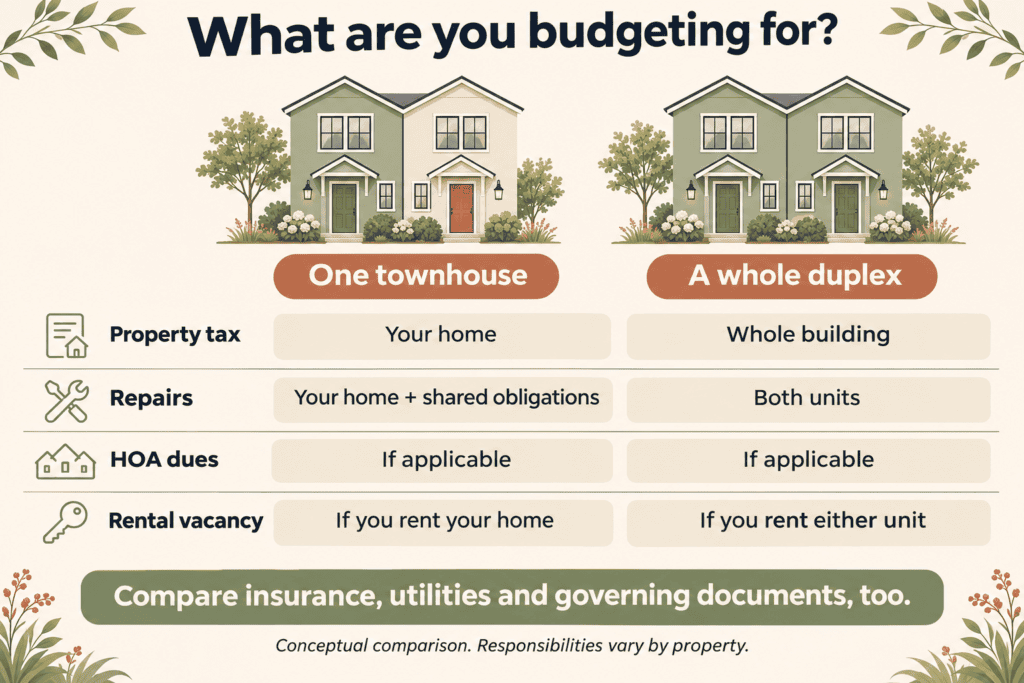
In a duplex you own outright, the whole building is yours. You can repaint, repair, and rent on your own terms. You also carry the whole building’s insurance and repairs, and a vacancy on one side hits your budget directly.
If two different people own the halves of a duplex, get the roof, shared wall, water line, and insurance arrangements in writing.
How Financing Works for Each
A townhouse is financed like any single family home. A duplex follows two to four unit rules, which usually means more paperwork and a closer look at how you will occupy the home.
An FHA loan allows a down payment as low as 3.5 percent on a two to four unit property if you live in one of the units. The lender expects you to move in within 60 days of closing and stay at least one year. Lenders also commonly count only part of the expected rent from the other unit when they calculate your income, often about 75 percent. If you buy a duplex as a pure investment and do not live there, expect a much larger down payment. A common figure for two to four unit investment loans is 25 percent.
Conventional loans on a duplex vary by lender and program, so ask for the exact down payment terms in writing.
Down payment help in North Carolina leans toward townhouses. The NC Housing Finance Agency’s NC 1st Home Advantage Down Payment offers $15,000 to eligible first time buyers and veterans, and the agency’s published list of eligible property types names single family homes, townhouses, condominiums, and new manufactured homes. Duplexes are not on that list. Income limits, price limits, and other rules apply, and one source limits the program to targeted areas, so confirm eligibility for the exact address with a lender.
| Financing point | Townhouse | Duplex |
|---|---|---|
| Underwriting | Single family rules | Two unit rules |
| FHA minimum down payment | 3.5 percent | 3.5 percent, if you live in one unit |
| Rental income used to qualify | Not applicable | Part of the other unit’s rent, if you occupy one side |
| NC $15,000 down payment program | Listed as eligible | Not listed |
| If you do not live there | Investor financing | Investor financing, often 25 percent down |
What Daily Life Looks Like
Think about a normal Tuesday. Where do you park? How much do you hear through the wall? Who mows the grass?
Shared walls come first. A duet or end unit townhouse shares one wall, which means more windows, more light, and one neighbor to hear. A middle unit in a row shares two. Many duplexes share one wall too, or a floor and ceiling if the units are stacked. Sound depends more on how the wall is built than on the label, so ask about the construction and then stand in the home and listen.
Space is the next trade. A townhouse often lives across two or three floors, while a duplex tends to spread out on one level or side by side. The homes at The Enclave at 626 or The Enclave at 301 offer anywhere from 1,939 to 2200 square feet with three bedrooms, a rear load garage off a private alley, and an EV charger ready panel. That is a lot of room for an attached home, and it is why many buyers who start with a single family search end up touring a duet. If a detached house is still on your list, read townhome or single family home in Gastonia.
Upkeep depends on the HOA. In an HOA community, dues usually cover shared areas and sometimes exterior work. With no HOA, as at The Enclave, there are no dues and you handle your own home. In a duplex you own, you handle both sides.
Commute matters too. Itani estimates 25 to 30 minutes from The Enclave to Uptown Charlotte in normal traffic, but Interstate 85 backups can stretch that, so test the drive at the hour you would make it.
What Each Costs to Own in Gaston County
Start with property tax, because it is the cost buyers forget. In Gastonia, you pay Gaston County tax plus City of Gastonia tax. The county adopted a rate of 59.9 cents per $100 of assessed value for fiscal year 2027, and the city rate is 47 cents, for a combined 1.069 percent, per Gaston County Tax Office figures compiled by the Property Tax Almanac. On a home assessed at $300,000, that is about $3,207 a year. Bessemer City sets its own city rate and held it at 55 cents per $100 in its 2025 to 2026 budget, so check the current figure with the city before you run your numbers.
A duplex is taxed on the whole building, so the bill is larger, though rent from the second unit can help cover it. A townhouse is taxed on one home.
| Cost line | Townhouse | Duplex |
|---|---|---|
| Property tax | One home’s assessed value | The whole building’s assessed value |
| Insurance | Your home, or a policy plus HOA master policy | The whole building, and landlord coverage if you rent a unit |
| Utilities | Usually one set of meters | Check whether each unit has its own water, sewer, and power |
| HOA dues | Possible, ask first | Rare |
| Repairs | Your home only | Both units |
| Vacancy risk | None if you live there | Real, if you rent the other unit |
At The Enclave at 626, each home has its own water, sewer, and power billing, with no submetering, and there are no HOA dues. That keeps the monthly picture simple. For a broader look at monthly costs, see our post on renting vs. buying in Gastonia.

Renting Out a Townhouse or a Duplex
This is where the two home types split most clearly.
A duplex suits the owner who lives on one side and rents the other, often called house hacking. The rent can offset your mortgage, and a lender may count part of it toward qualifying. The tradeoff is the work: screening tenants, handling repairs, and managing a lease on a wall you share with your own renter.
A townhouse rental is the whole home, usually after you move out. HOA rules may limit rentals or set minimum lease terms, so check the documents. At The Enclave at 626, there is no HOA and no restriction on renting or on lease length.
Be careful with assistance programs. NC Housing Finance Agency programs require you to live in the home as your primary residence, and converting it to a rental can trigger repayment. If you plan to rent soon, talk to a lender first. Investors can start on our investor page.
Local Rules in Charlotte, Gastonia, and Bessemer City
Zoning shapes which home types you will see and what you can change later.
In Charlotte, the Unified Development Ordinance took effect on June 1, 2023, and its Neighborhood 1 districts allow single family homes, duplexes, and triplexes on lots that were once zoned only for single family use. The city has been revisiting its triplex rules, so confirm the current rules for any lot. Practically, a Charlotte buyer will see more new duplexes and infill in established neighborhoods. Check the lot’s zoning and any deed covenants before you assume a use. Our Charlotte new construction guide covers the buying process.
In Gastonia, the planning office notes that most higher density residential projects require a rezoning. That means you should not assume you can add a unit to a lot later, and a duplex on a lot not zoned for it is a risk, not a bargain.
Bessemer City runs its own planning and zoning, so ask its planning department about any lot you are considering. Itani has built single family homes in Bessemer City and Ranlo and townhomes in Gastonia, and the advice is the same in each: ask the city before you count on a use.
Which One Fits Your Plans
| If this sounds like you | Lean toward |
|---|---|
| You want to own your land and keep decisions in your hands | Townhouse or duet |
| You want help from the NC $15,000 down payment program | Townhouse |
| You want a tenant to help pay the mortgage while you live there | Duplex |
| You want the simplest loan and the fewest landlord duties | Townhouse or duet |
| You are an investor who wants one tenant and separate utilities | Townhouse or duet with no rental limits |
| You want more privacy than a row of townhomes offers | Duet or duplex |
| You commute to Charlotte and want room to grow | Larger townhouse or duet near Interstate 85 |
Conclusion
The choice between a townhouse and a duplex comes down to ownership and your plan. If you want your own land, a simple loan, and fewer landlord duties, a townhouse or duet fits. If you want a tenant to help pay the mortgage and you accept the work that comes with it, a duplex can make sense.
Wherever you search, whether in Gastonia, Bessemer City, or Charlotte, ask for the deed, the lot lines, the HOA documents, and the loan terms before you tour twice. If a duet style townhome with no HOA sounds right, read the Enclave at 626 FAQs or 7 reasons to explore The Enclave, then request a tour with Itani Development.